Patient overview
Review relevant history and current context before the appointment.

The Vitaspan platform
Bring fragmented records into a patient-controlled Living Health Record. Help your team prepare for consultations, create reports around your clinical methodology and review documentation more consistently, alongside your existing clinical systems.
A clearer patient picture before the consultation.
See relevant history, results and documents together in a record that follows the patient across care settings.

Review relevant history and current context before the appointment.
Understand consultations, investigations and care transitions in sequence.
Return to the documents behind the organised information.
Support authorised access across the patient's care relationships.
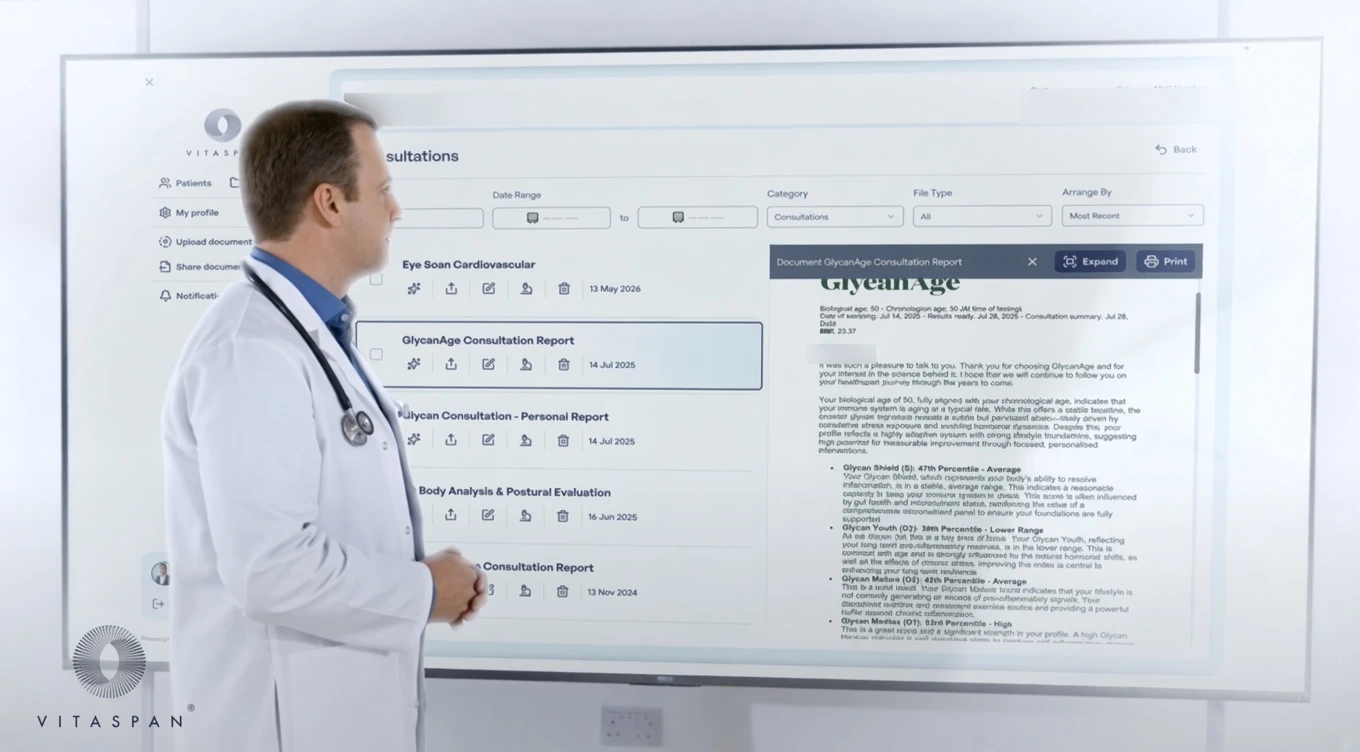
Bring together records from your clinical systems, other providers and patients themselves. Structure that information into a Living Health Record that supports clinical review and AI-assisted insight.
Explore how your records connect →Vitaspan acts as a steward of patient information.
Sharing within the network remains governed by appropriate permissions; joining the network does not grant automatic access to patient records.
Your clinical method, reflected in every report.
Turn your clinic's methodology and the patient's longitudinal information into structured reports and personalised care-plan drafts. Reduce repetitive preparation while keeping review and approval with your clinicians.
Set the information, report structure and clinical approach your team uses.
Bring relevant patient information into a structured starting point for review.
Your clinicians check, edit and approve the output before it is used in care.
Your clinical methodology remains your intellectual property. The report workflow is configured around your service and agreed clinical review process.
Review more records. Focus on the exceptions.
Check consultation notes and reports against your clinic's documentation policies. Surface potential omissions, see the relevant requirement and direct reviewer attention to the records that need it.
Review against the documentation requirements your organisation sets.
See which requirement may be missing from a record.
Check the source note and confirm the appropriate response.
A flag identifies a potential documentation omission. It does not establish that care was not delivered or replace clinical judgement.
Predictive intelligence · Apollo Hospitals
Explore Apollo models for cardiovascular risk, prediabetes and liver fibrosis. Vitaspan brings supported model outputs alongside the Living Health Record, helping clinicians consider risk in the context of the patient’s history and results.
Estimate ten-year cardiovascular-event risk using clinical history, lifestyle information and routine measurements. Support more focused conversations about prevention, further assessment and follow-up.
Inputs: Demographics, body measurements, blood pressure, lifestyle factors and relevant medical history.
Outputs: Risk score and category, with contributing risk factors for clinician review.
Intended use: Support preventive cardiovascular risk assessment in outpatient and health-check settings. The model estimates ten-year cardiovascular-event risk to inform clinician-led assessment and follow-up. It does not establish a diagnosis or replace clinical judgement.
Assess the likelihood of previously undiagnosed prediabetes or type 2 diabetes using personal, lifestyle and medical-history information. Help clinicians identify where further assessment and testing may be appropriate.
Inputs: Age, body measurements, family history, lifestyle factors, relevant medical history and symptoms.
Outputs: Risk score and category to support clinician-led assessment.
Intended use: Screening support for people without an established diagnosis; it does not establish a diagnosis.
Assess the likelihood of significant liver fibrosis in people with non-alcoholic fatty liver disease. Bring clinical history and blood-test information together to support decisions about further liver assessment and specialist review.
Inputs: Demographics, relevant medical history and laboratory results, including liver enzymes, albumin, bilirubin and platelet count.
Outputs: Risk score and category relating to F2–F4 versus F0–F1 fibrosis.
Intended use: Support assessment within the population described by the model; it does not establish a diagnosis or replace appropriate investigations.
Model availability and suitability depend on the intended use, population, market and deployment. Outputs support clinician assessment and do not establish a diagnosis.
“Partnering with Vitaspan aligns perfectly with our mission to deliver proactive, predictive care at scale.”
Read the full endorsement
“Partnering with Vitaspan aligns perfectly with our mission to deliver proactive, predictive care at scale. Vitaspan’s focus on clinical utility, structured health data, and regulatory compliance makes them the ideal partner to amplify the reach and effectiveness of our AI algorithms. Together, we are committed to reducing disease burdens and enhancing health outcomes in healthcare systems facing increasing pressure.”
Dr. Sangita Reddy
Joint Managing Director, Apollo Hospitals
Start with the patient group, information sources and workflows that matter to your team. We will agree the connections, product scope and review responsibilities before implementation.
Define one patient group and one workflow where connected information would be most useful.
Agree the source systems, available records, supported connection routes and required access permissions.
Run the workflow with defined clinical review, correction and approval responsibilities.
Compare the pilot with the agreed baseline before deciding whether and how to extend it.
Explore the patient record, report preparation and documentation review in a demonstration shaped around your service.